I have a question for @Stephen about the “Bayesian Time Machine” (BTM).

In the excellent pod cast you warned of the potential for changes in the sampled population over the sequential time intervals (for example in baseline care). To take this one layer up, how does the BTM accommodate changes in disease mix composition (for example different species pneumonia types in RE-MAP CAP) within the trial over the time intervals in a broadly gated, cause-agnostic RCT (CAR)?
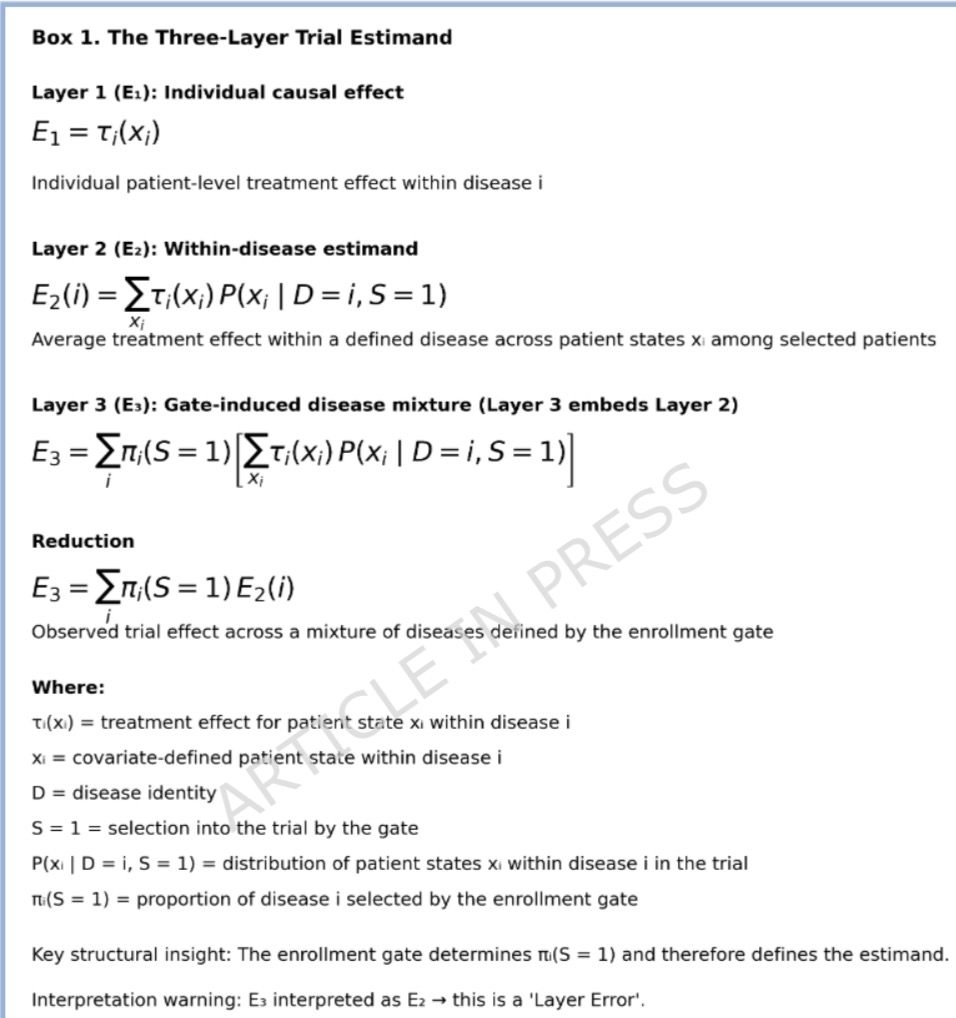
In the layered estimand framework (below), the third-layer estimand, E3, is the top, mixture-weighted average of disease-specific average treatment effects (E2), each averaged over its within-disease covariate distribution. For each of the ten time intervals discussed, the disease proportions may change, with temporal changes in the disease agnostic gate sampled population, and this determines the mixture weights and therefore that specific time interval’s E3. So as those proportions change, E3 may change or even reverse polarity despite every disease-specific E2 remaining constant. (The cause mixture paradox).
My question is: If the BTM is applied to a cause agnostic RCT (CAR) and studies a changing disease mix over time, doesn’t this require explicit justification for temporal borrowing.
In a CAR (such as the above mentioned REMAP-CAP), an unchanged entry gate cannot supply that justification as it would in an RCT gated for trial causal integrity. Does the BTM formulation discussed accommodate this mixture-driven treatment-effect variation, or would it require additional disease-by-treatment modeling and an explicitly defined target mixture?
In explanation, one can substitute E2t1, E2t2…E2ti and E3t1, E3t2…E3ti, for E2 and E3 in the framework below.