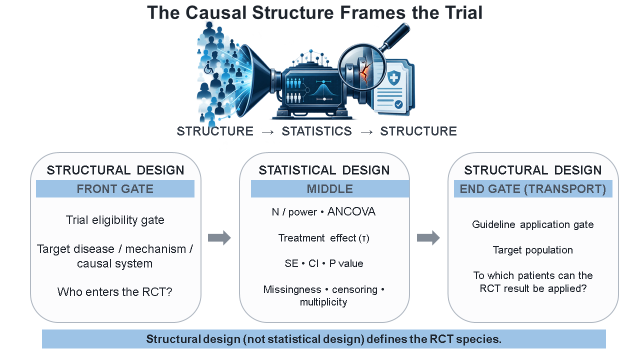
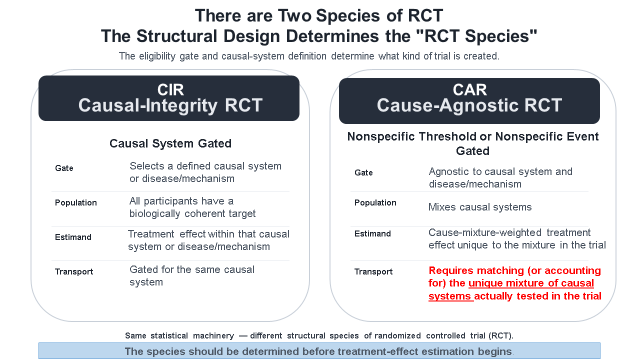
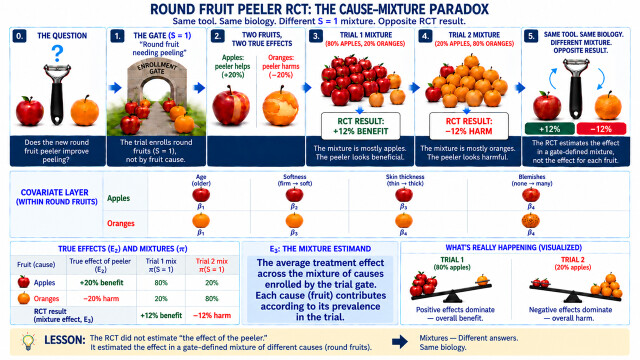
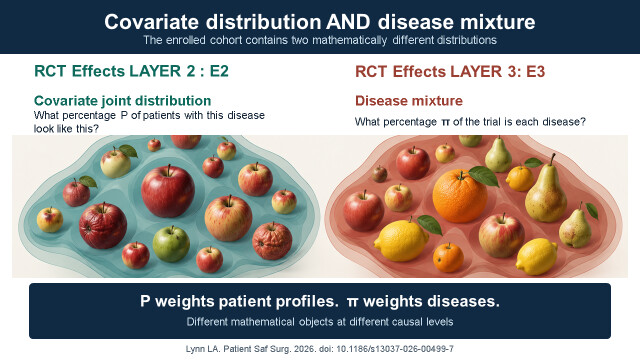
Iván Díaz and I have engaged in a long discussion on X.com about the role of causal formalism in randomized clinical trials. This was motivated somewhat by my blog article Causal by Design where I argued that straight-up RCTs, i.e., those in which all covariates are measured at time zero or earlier and there are no interruptions in the outcome flow (e.g., no truncation by death) allow us to do causal inference without the need for causal formalism. I also clearly wrote that there are more complex situations where randomization is used but post-time-zero things happen that makes interpretation difficult and calls for formal causal inference.
Díaz has posted a long thread laying out challenges to those like me who feel that causal formalism has a more narrow usefulness in RCTs. It is here on X and on BlueSky and is reproduced below. This topic page is intended to be a place for responses to Iván’s thread, and hopefully for him to respond to the responses.
To frame the discussion it is important to first state the main purpose of a parallel-group RCT: to make sound decisions about licensing a product for sale, or about using an available therapy in practice, by quantifying evidence for a benefit for those assigned to get the treatment in comparison to those assigned to a comparator. Like clinical practice, RCTs cannot control actual use of a therapy in a patient, and there is a distribution of adherence patterns over time. Another framing of the discussion is understanding why I use the term causal by design when referring to a straight-up RCT. This refers to a situation where by design there are only two explanations for a treatment difference: randomness in data (plain old bad luck, addressed by using probabilities to handle uncertainties), and the experimental intervention.
Now to Iván Díaz’s posts.
- Over the last few days I have been discussing the role of formal causal inference in RCTs, and in general the role of formalism and rigor in statistics in twitter with @f2harrell. Thread with an example for why both are fundamental for biomedical research:
- @f2harrell and others claim that no formal causal models are needed in RCTs.
- He rejected even the potential outcomes framework, the first formalization (100 y/o) for why “RCTs are causal by design”. To delve into that position, I posed a problem to him:
- Consider a randomized antidepressant trial examining the effect on weight Y at month m. Some participants die before m. Let A be treatment and S survival. A student proposes comparing arms only among those with S=1.
- Can Frank give the student conditions under which E[Y|A=1,S=1]−E[Y|A=0,S=1] identifies a causal effect?
- I did not get a straight answer, but one of his responses was that any assumptions needed to solve the problem would necessarily be untestable.
- He couldn’t have been certain about that without formalism, but it is false. Below I show a simple solution using potential outcomes.
- In the same way, no one can be certain why RCTs “are causal by design” without the formalism Neyman gave us 100 years ago.
- This lack of rigor in a mathematical discipline is concerning. The consequences of rejecting formalism extend beyond this point on RCTs.
- As the student in this example, I would be disappointed to learn that I had been taught something incorrect because my training lacked sufficient rigor.
- As a collaborator, I would be disappointed if a possible solution to my problem was missed because the formalism was rejected.
- As a patient, I might be denied important information that could help me make a treatment decision because an analysis was dismissed without a rigorous causal argument.
- Here is the solution: let S(a) and Y(a) be survival and weight under assignment a. Y(a) exists only if S(a)=1.
- An observed survivor could die under the other treatment, so one of Y(1),Y(0) may be undefined. The causal effect may not even exist.
- We therefore first need to say what “causal effect” means. I use “average causal effect” to mean the mean difference between the same individuals’ potential outcomes, in a population where both outcomes are defined.
- Now assume S(1)=S(0) almost surely. In words, treatment changes no individual’s survival at m. By consistency, S=S(A)=S(1)=S(0). Both potential weights therefore exist for everyone with S=1.
- It follows that E[Y(1)−Y(0)|S=1] is a well-defined average causal effect among observed survivors.
- For each a, consistency gives E[Y|A=a,S=1]=E[Y(a)|A=a,S=1]. Since S=S(a), randomization gives E[Y(a)|A=a,S=1]=E[Y(a)|S=1].
- Therefore, E[Y|A=1,S=1]−E[Y|A=0,S=1]=E[Y(1)−Y(0)|S=1]. Under S(1)=S(0), the proposed survivor contrast identifies a well-defined causal effect. That is the theorem.
- S(1)=S(0) is Fisher’s sharp null and has testable implications. In particular, it implies P(S=1|A=1)=P(S=1|A=0), so the assumption is falsifiable.
- Partial-identification bounds on P[S(1)=S(0)] can also be used. So assumptions capable of solving this problem are not necessarily untestable. The formalism makes that easy to see.
- Intercurrent events do not create the need for a formal definition of causality or a formal identification argument. They expose a need that was already present in the uncomplicated trial.