DECAF is hitting the headlines at the American Heart Association this weekend (https://bit.ly/4p2s1pD) and has been simultaneously published in JAMA (https://jamanetwork.com/journals/jama/fullarticle/2841253).
Simply, it takes a group of coffee drinkers with persistent Atrial Fibrillation or flutter and randomises them to keep drinking coffee as normal or to abstain from coffee and all caffeinated products. They excluded those who said they thought they couldn’t abstain. The outcome was a recurrence of AF or flutter over 6 months.
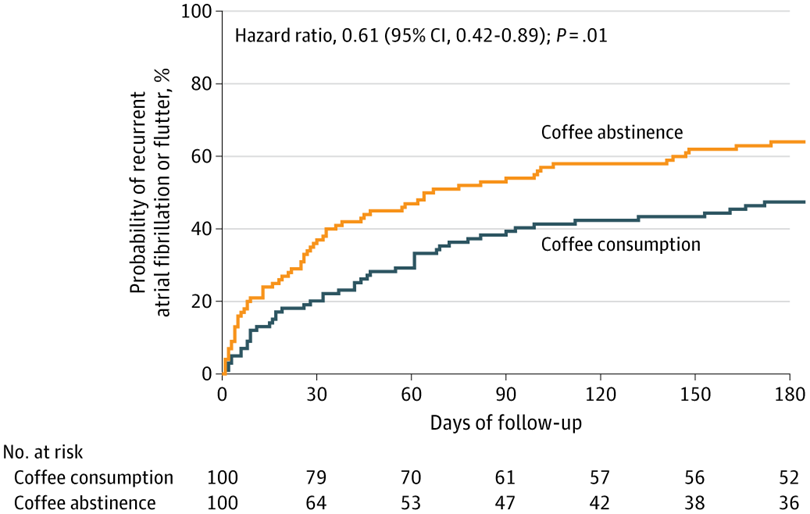
The results were 45% recurrence in the coffee consuming group and 69% in the abstinence group.
The study & media are reporting that coffee consumption may lower the rate of AF. The abstract results state: “In the primary analysis, AF or atrial flutter recurrence was less in the coffee consumption (47%) than the coffee abstinence (64%) group, resulting in a 39% lower hazard of recurrence (hazard ratio, 0.61 [95% CI, 0.42-0.89]; P = .01).”
For me this is very wrong. It is the coffee consuming group that is the control arm not the abstinence group. The results should be something like ““In the primary analysis, AF or atrial flutter recurrence was more in the coffee abstinence group (64%) than the coffee consumption group, resulting in a 64% higher hazard, resulting in a 64% higher hazard of recurrence (hazard ratio,1.64 [95% CI, 1.12-2.38]; P = .01).” The advice being given should be that (at least for now) better to avoid going cold turkey on the coffee.
If they wanted to know if drinking coffee reduced AF then that study should start with non-coffee drinkers.
What is your take on this?
4 Likes
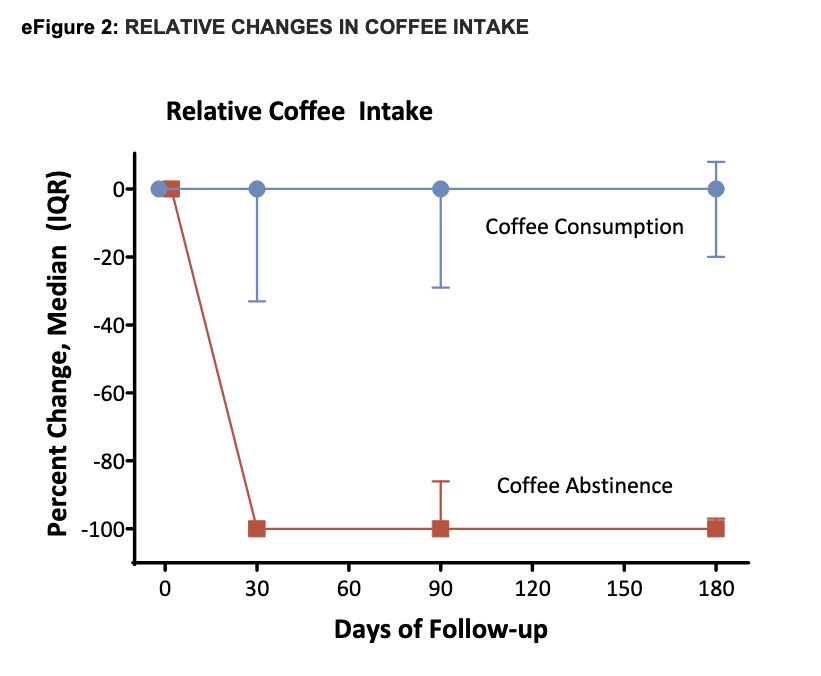
Please comment on whether the intervention was randomized and what was the compliance to assigned treatment.
1 Like
Yes it was randomised 1:1, n = 200. Open label of course. The attached figure from the supplement is the only indication about compliance.
2 Likes
In the limitations: From the paper:
“Seventh, adherence in the abstinence group was also suboptimal, with only 69% not consuming any coffee. However, this does raise the possibility that these results might underestimate the true magnitude of benefit from coffee.”
1 Like
Thank you for spotting this… I missed it. Of course, my take is that it means it underestimated the true magnitude of harm from trying to go cold turkey.
Very interesting and would explain the rapid separation but the curves widen for about 45 days so this is hard to causally explain on that basis. Then again we have no known pathway for the findings so why couldn’t withdrawal effect be 45d.
It’s a
JAMA decided they didn’t want my letter about this study. I await to see if any others will point out the flaw. In the meantime, I’ve self published my letter. https://www.researchgate.net/publication/398754914_Going_cold_turkey_from_caffeine_may_be_harmful
8 Likes
This is embarrassing for JAMA. Whenever a paper is published without adequate methodologic peer review, and a letter to the editor from a knowledgeable methodologist is ignored, JAMA is perpetuating bad science instead of serving as a gatekeeper of good science.
5 Likes
I contacted the authors and had a lovely and very swift reply. It looks like others may have raised the same issue I did and that there will be letters and responses in JAMA soon. While I still disagree, it will be good that the issue will get a hearing.
One thing that occurred to me and my gut is telling me could have some statistical problems but may have some value was to construct Kaplan-Meier curves for the whole cohort prior to randomisation (perhaps running time backwards) and compare them to the two study arms. Possibly some kind of paired analysis would be best, though I am not immediately sure how one would go about that. Thoughts anyone?
2 Likes