RCTs: How should we model uneven temporal spacing and changes in direction and magnitude?
Hey everyone,
I was peer-reviewing a paper and I got this doubt. Which model would you pre-register for this study?
Assessments were conducted at baseline (V1), approximately one month later but before surgery (V2), and six weeks after surgery (V3).
The expected trajectory was an improvement from V1 to V2, followed by a 50% loss of that improvement from V2 to V3.
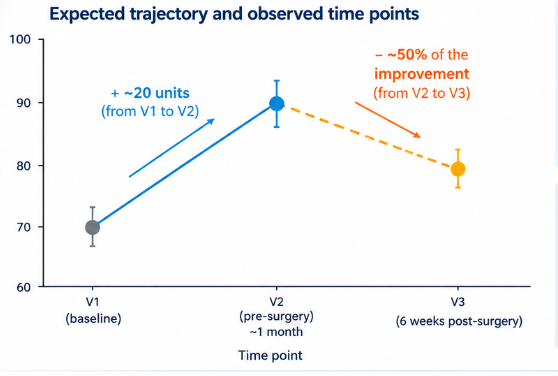
The challenge is that the time intervals are unequal, and the expected changes differ in both direction and magnitude.
Which approach would you choose?
-
Splines: With only three assessment points, I suspect that modelling the trajectory using splines would be unnecessarily complex and potentially unstable.
-
Conventional change scores: I believe these would underestimate at V2 and overestimate at V3.
-
Two separate ANCOVAs: One ANCOVA comparing V1 and V2, and another comparing V1 and V3. This would allow us to estimate the effect at each follow-up separately, but would not directly model the full trajectory.
Would you recommend any other approach?
Bonus question: Is there a meaningful reason to test the contrast between V2 and V3? I often see authors report this comparison, but I am not always sure what additional information it provides beyond comparing each follow-up with baseline.
Thank you!
 Yes, it is an RCT. I was assuming that the control group remains flat.