If SR is given by:
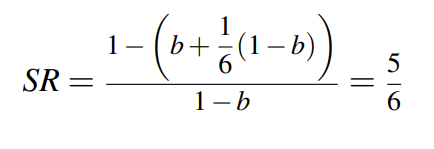
Then this defaults to 1-a where a is the probability of death when the harmful intervention is applied and therefore has to be a constant.
Yes. This is why the survival ratio is constant across different baseline risks (given a specific, simple data generating mechanism that may occur when exposure increases risk of death). Importantly, no similar result exists for other measures of effect.
Do you think this is somehow an argument against the survival ratio? If so, you need to flesh out the argument and give me something to respond to
Those of you who followed this thread may be interested in an upcoming discussion meeting at the Royal Statistical Society, which will be held on March 24th. Sign up at RSS - Discussion paper meetings , either for the physical meeting at Imperial College or for the livestreamed event.
This work was originally motivated by our interest in models based on the switch relative risk, but took on a life of its own and turned into a new, general framework for regression modelling that includes most existing models as special cases.
RBC can be understood as a principled language for modular model building, such that the statistical properties of each parameter can be understood as being determined by the algebraic properties of the flow used to construct a model based on that parameter.
5 Likes