I worked for 4.5 years as a medical device sterilization technician.
In sterilization science we use a concept named Sterility Assurance Level (SAL) to ensure the safety of medical devices after sterilization. However, I believe that the definition of SAL is flawed.
Since I’m no statistician and I don’t use statistics at the professional level (let alone at the level discussed in this site), I’m posting this question here to understand whether I’m right or wrong.
I will state the problem only with the necessary mathematical assumptions. I will leave all things related to microbiology, sterilization technology, human factors and so many other things aside. This is because the definition of SAL is purely mathematical and so I whish to address its possible mathematical flaws (I can deal with all its other non-mathematical flaws).
I can explain SAL in these terms:
-- Consider a medical device contaminated with 10^6 microorganisms. The medical device is subjected to a sterilization method (like moist steam) that kills the microorganisms at a fixed rate.
-- We define the decimal reduction time, or D-value, as the time necessary to kill 90 % of the surviving microorganisms.
-- A table can show how the microorganism population evolves during sterilization:
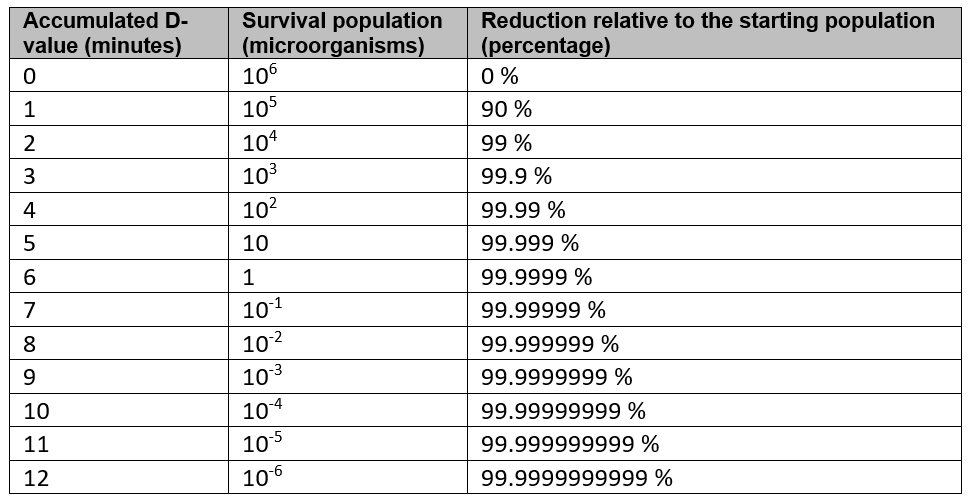
The usual interpretation is this:
-- According to the table, after 12 D-values there will be 10^-6 viable microorganisms in the medical device. So, if we consider 10^6 medical devices initially contaminated with 10^6 microorganisms each (making a total population of 10^12 microorganisms), and if they are all subjected to the same sterilization method, in the end there will be just 1 viable microorganism. In other words, there will be 1 contaminated medical device among the 10^6 medical devices.
-- SAL is the probability of ending up with 1 contaminated device in a group of devices after a decontamination process which takes a specific time. In this case SAL is 10^-6 and indeed current medical device sterilization processes are tuned to achieve a SAL of 10^-6.
Again, I will only address the mathematical aspects (there is a lot more to consider that compound the problem and make SAL a flawed concept). My problem is purely mathematical and I’m asking for help to understand whether my reasoning is flawed or not:
-- In the same way that I can throw a dice 6 times and never get a “5”, and I may throw it a lot of times and never get such result, if I define SAL as a probability, then I can end up with far more than 999.999 decontaminated devices and, at the same time, end up with a device severely contaminated with thousands of microorganisms. However, the assumptions in this discussion, as well as the results in the table, are not about a random experiment.
-- Is it correct to consider a population of 10^12 microorganisms as the same as 10^6 populations of 10^6 microorganisms? I believe not. The assumption is that all populations die at a fixed rate. If we separate them, after 7 D-values all populations are dead. If we join them, the single population is all dead after 13 D-values. If we consider the separate populations as a single one, than we would find that each separate population would not decay exponentially or continuously, just that the sum of all decays would be a decreasing exponential. But this contradicts the initial assumption that the killing rate is constant for each individual population.
I’m not an English-speaking native, so if the problem is not clearly started, please do let me know. And thanks in advance!