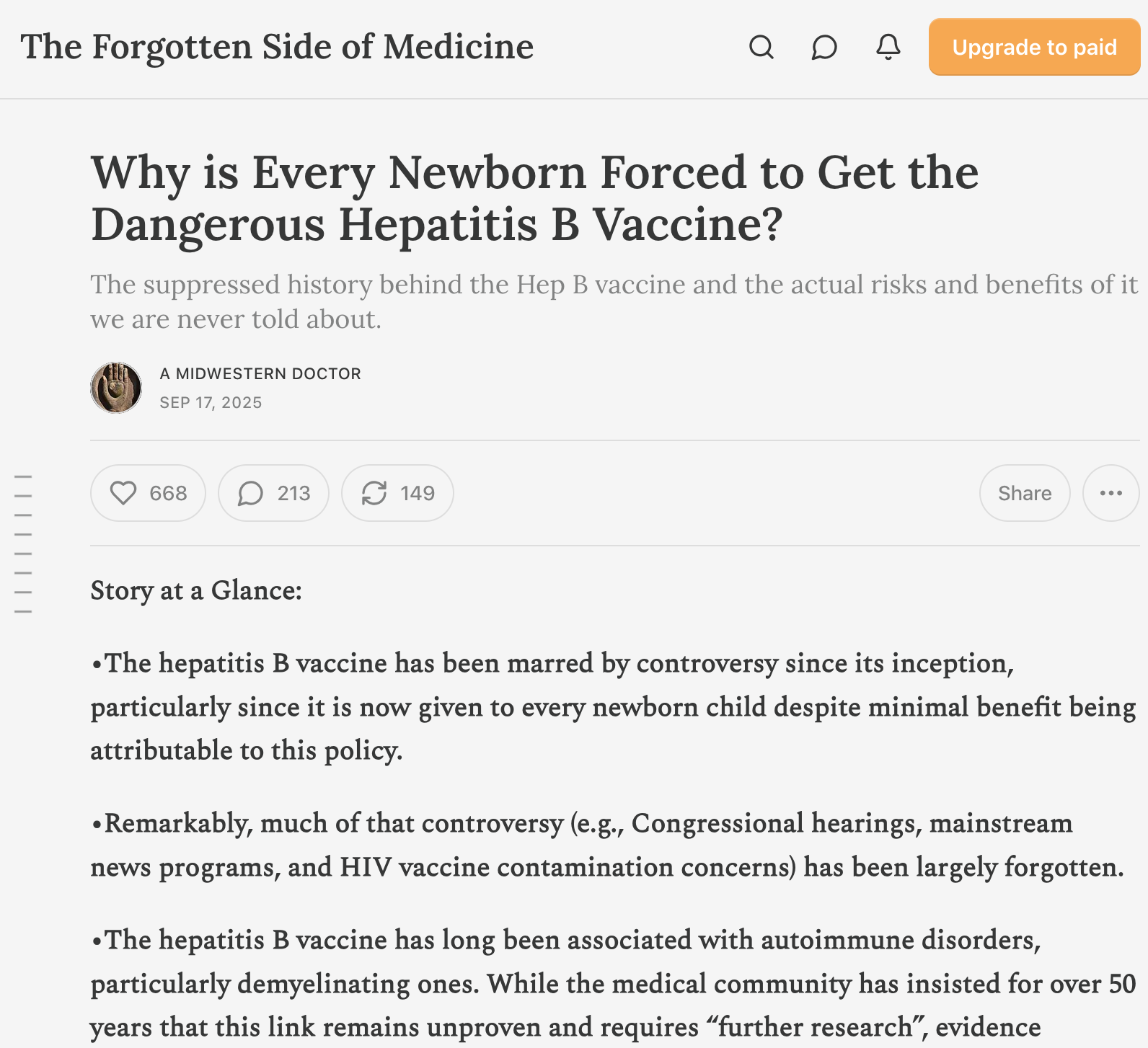
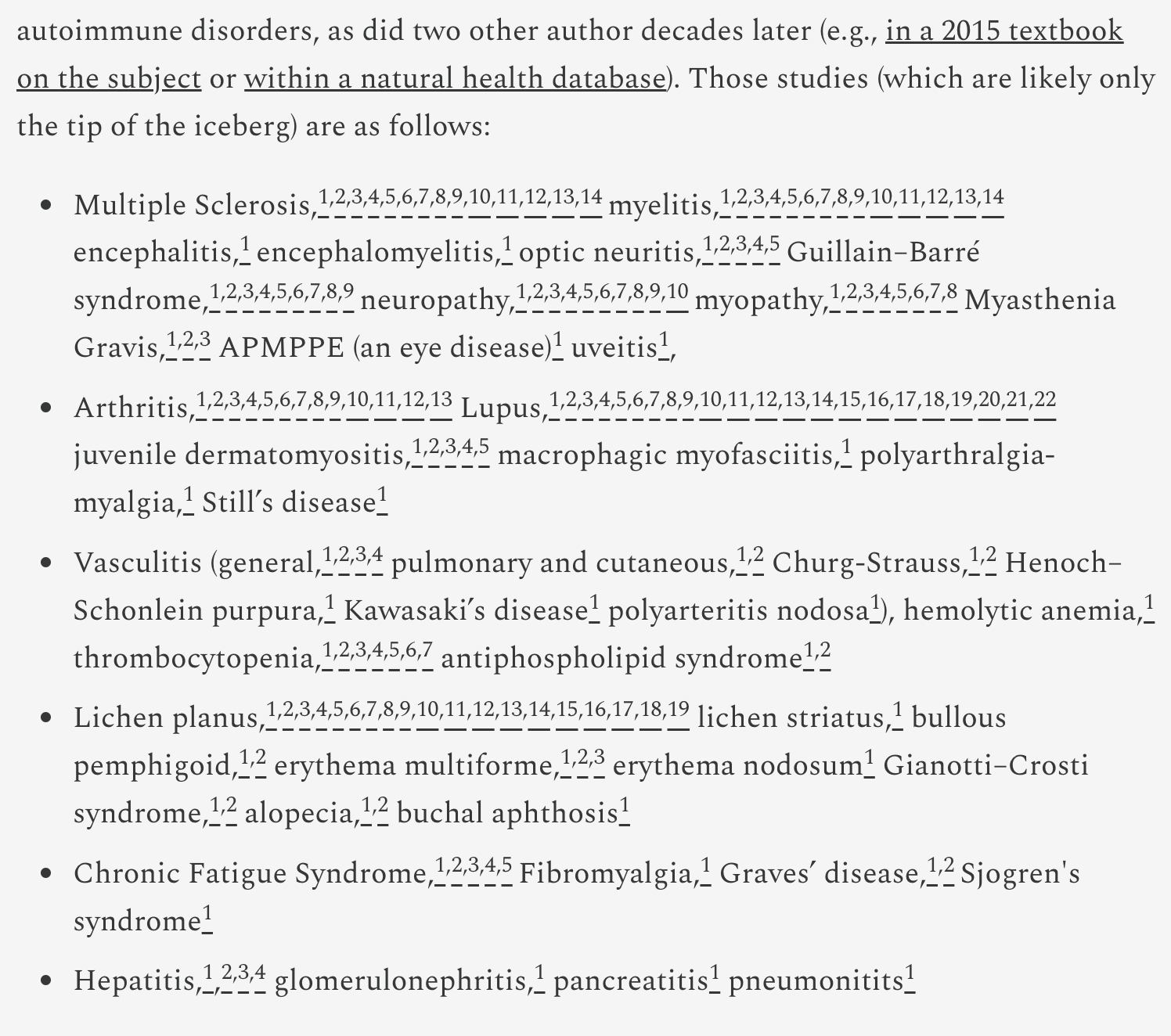
Below is a screen shot of a popular blog post challenging the hepatitis B vaccine in newborns. The post mentions many studies on the side effects of the hepatitis B vaccine.
Thought to draw upon the expertise in this forum to rigorously, unbiasedly assess the studies mentioned in the post. Almost all of the studies (still working on a few) and whether they involve biostatistics or not (ie, any studies analyzing multiple people, using databases, etc), and, if so, a link to the study, are in this spreadsheet. If anyone is interested in helping to analyze a study, feel free to mark X in the designated column, so others not repeating work and to put comments in the spreadsheet next to the X or in the forum below.
Note that although the studies are organized according to their ordering in the blog post (screenshot of the part of the blog where references are made is also below), many are from a paper by Burton A. Waisbren, which is also cited in the post (possibly better to organize them according to this paper, but in general can interchange order if needed in future)–I am assuming most of the references in the Waisbren paper also in the post and vice versa.
If anyone knows this area better and has another sense of how to go about analyzing this literature, also open to help. Otherwise, in general, possibly this can give a start on critically appraising these studies and wading into this literature.
3 Likes
I feel like it might also be a good idea to look at the studies showing effectiveness of the vaccine, as a contrast. I don’t know the literature but it’s presumably pretty convincing.
1 Like
This doesn’t answer the questions but I think at the heart of the issue, exactly as in the case of hormone replacement therapy, a fundamental misunderstanding of risk-benefit tradeoffs. The key question should be “Are kids better off with the vaccine than without it?” and we should define “better off” by enumerating all the bad things that can happen to kids that have any relationship with vaccines or relevant disease processes. This can form the basis of a utility-based analysis or simpler ordinal response analyses. This will make proper tradeoffs and will also expose that even awful clinical events will properly get little weight when they are much more rare than the events the vaccine is trying to prevent. Comparison of ordinal outcome scales between vax and untaxed kids is in order.
2 Likes
The policy universality presumed here lies at the heart of the [political] problem. There’s widespread resentment against the gubmint deciding such trade-offs for us — especially with inscrutable methods controlled by ‘experts’. This isn’t just a view held by rustic types, either; here’s a quote from Hayek’s 1944 The Road to Serfdom:
The influence of these scientist-politicians was of late years not often on the side of liberty: the “intolerance of reason” so frequently conspicuous in the scientific specialist, the impatience with the ways of the ordinary man so characteristic of the expert, and the contempt for anything which was not consciously organized by superior minds according to a scientific blueprint were phenomena familiar in German public life for generations before they became of significance in England.
https://www.agathonlibrary.com/wp-content/uploads/2024/11/Hayek-Friedrich-the-road-to-serfdom-text-and-documents-zlib.pdf#page=248
So a more fruitful initial framing will condition on individual circumstances, acknowledging that there is a decision to be made at the individual level. If mom tests positive for Hep B, the decision-problem is a trivial one AFAIK. So the two cases worth considering are if mom tested negative, or never got tested. (Population base rates, and rates of false negative tests should be included in the calculations.) The decision-trees with probabilities on leaf outcomes could make a start at a meaningful patient decision aid.
Playing a divide-and-conquer game of citation whack-a-mole against an anonymous Midwestern Doctor is probably a losing proposition.
Edit: Scott Gottlieb offered some relevant probabilities on Face The Nation this past Sunday: Transcript: Scott Gottlieb on "Face the Nation with Margaret Brennan," Dec. 7, 2025 - CBS News. It’s interesting to note that even he (an AEI Sr. Fellow!) offers a population-level framing for this policy question.
3 Likes
I appreciate that the replies mention expected utility / risk-benefit (and how the decision itself needs to be tailored to specific challenges scenarios, such as unknown maternal hepatitis status). Although I think about expected utility a lot, I realized after reading the replies that I had not really done so here—maybe a sense of urgency caused me to skip the systematic expected utility-based approach.
I do think that to have expected utility / risk-benefit discussions, it’s important that the risks be accurately estimated. I am not sure that’s the case here. The referenced studies are mostly case studies (for a vaccine given so often, different cases will appear at random) and many of the studies involving multiple subjects are, as far as I can tell, observational, at least in humans.
I do wonder how to best go about trying to help with all this. I think that this blog and the main paper it cites are read quite a bit, and the overall sentiment is leading to changes in vaccine schedules. As mentioned here, I can see that this may be partly a reaction to blanket recommendations, which can appear to infringe upon autonomy (although of course with vaccines it’s difficult because autonomy interacts with group beneficence). I agree that a utility-based study would be helpful.
1 Like