This is motivated by my desire to translate Bayesian conclusions such as I arrive at here into plainer language. If I find that the median of the posterior distribution over some parameter \theta is less than m, then I could say,
It is more likely than not that \theta < m.
But I would much rather make the plainer statement that:
\theta is probably less than m.
How do people feel about this?
2 Likes
This probably (sorry) doesn’t answer your question directly, but there has been some work done on the “perception of probability words”, with an interesting history. Here is one short summary I found with a quick search.
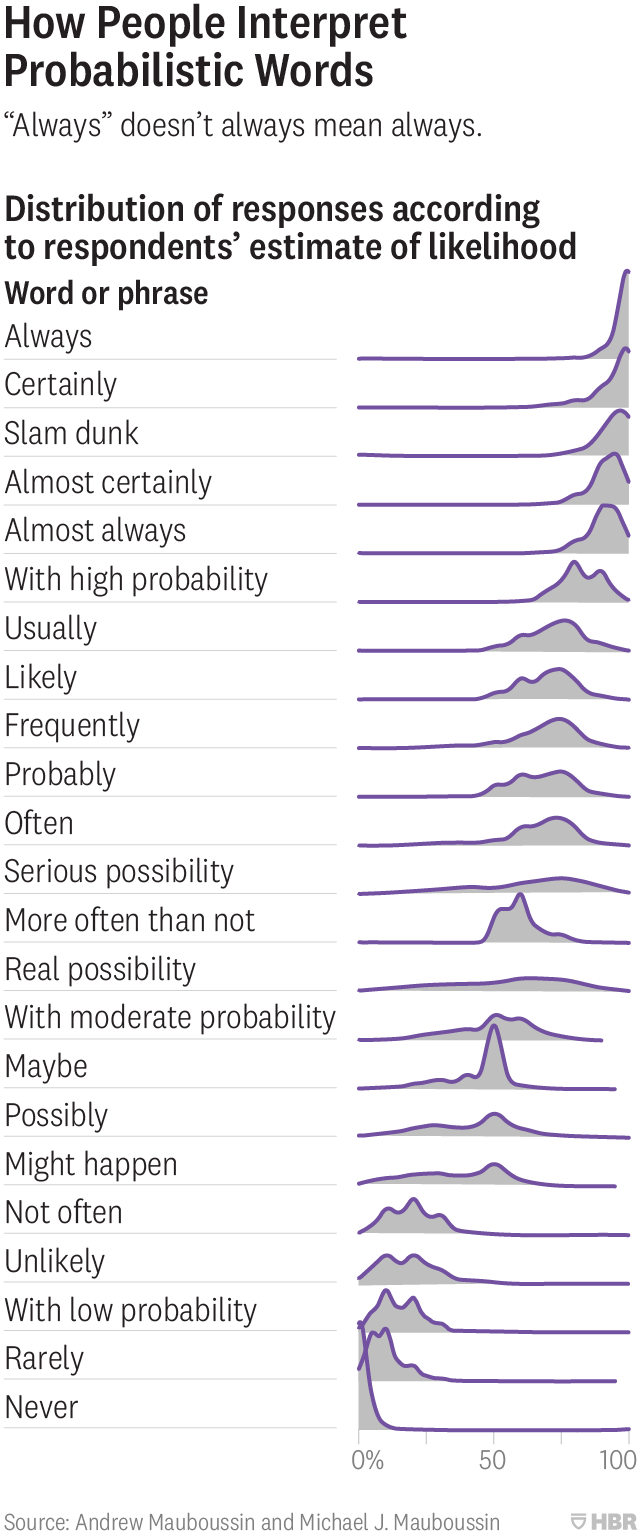
Personally I think your statement is reasonable, but it seems like respondents in these surveys tended to place a higher threshold on “probably” (and “probable”).
You might be able to find more applicable or modern results by following the links in the page above, or with a more thorough search than I did…
[edit: I just stumbled on this Wikipedia entry, which might have some further rabbit holes to follow - Words of estimative probability - Wikipedia ]
2 Likes
Thank you, Mark! This is very much the sort of thing I’d hoped for. It gives me a little ammunition in case reviewers object, but also serves as a caution, given that only a few people in that interactive graphic put ‘probably’ at 50–51%.
I get into this here where I suggest that the word “probably” is fine to use as long as it appears in language such as “the drug probably (0.54) causes a reduction in blood pressure” and 0.54 is the current posterior probability and the prior and data model are documented nearby.
3 Likes
This seems an excellent general practice to adopt. In my particular case here, the parentheses would have to read somewhat mysteriously (0.5+\epsilon); but a footnote could also serve the same purpose.
1 Like
For me I would not say probably as I think it is misleading. I would rather say the probability the drug reduces blood pressure is slightly more than half (54%).
1 Like
I don’t disagree with you but what would be misleading about “probably” per se?
1 Like
I think it implies cognitively something that is more likely to happen than with about a 50/50 chance. 54% vs 46% to me is close to a coin flip and so yes 54% is slightly higher but especially for a posterior on a parameter based on my understanding it makes the results sound more convincing than they are to say it is probably bigger than 0. It is more linguistic than a statistical argument but say I walk into an ER and they say “you probably are not having a heart attack” my expectation is they are thinking a smallish chance of a heart attack not a 46% chance. It is like when people say “the majority of x group think y” and the majority is over 50% but if it is just over it seems it could be described as a little bit more than half.
I do agree with you to always give the number but I also think the narrative used is important and I tend to always want to avoid the oversell. I might err too far in being cautious with my words though.
4 Likes
That just reminded me of the probabilitysurvey.com looking at how the public interprets probabilistic words:
4 Likes
This kind of statement in that context can’t properly end with a full stop and still make any sense decision-theoretically, since it omits the loss function. It could be followed by a semicolon, however, after which other causes would be listed. Then the loss function could be brought into the counseling explicitly, with explanation of how it informs your workup and management.
In a number of places (pp. 53, 78, 136, 228), Christian Robert’s The Bayesian Choice [1] teases a ‘duality’ between prior and loss function, although he leaves fuller development of this concept to references. Perhaps in the shadow of extremely influential loss functions, naked probability statements are inherently meaningless?
- Robert CP. The Bayesian Choice: From Decision-Theoretic Foundations to Computational Implementation. 2nd ed. Springer; 2007.
1 Like