As Andrew rightly notes in the editorial:
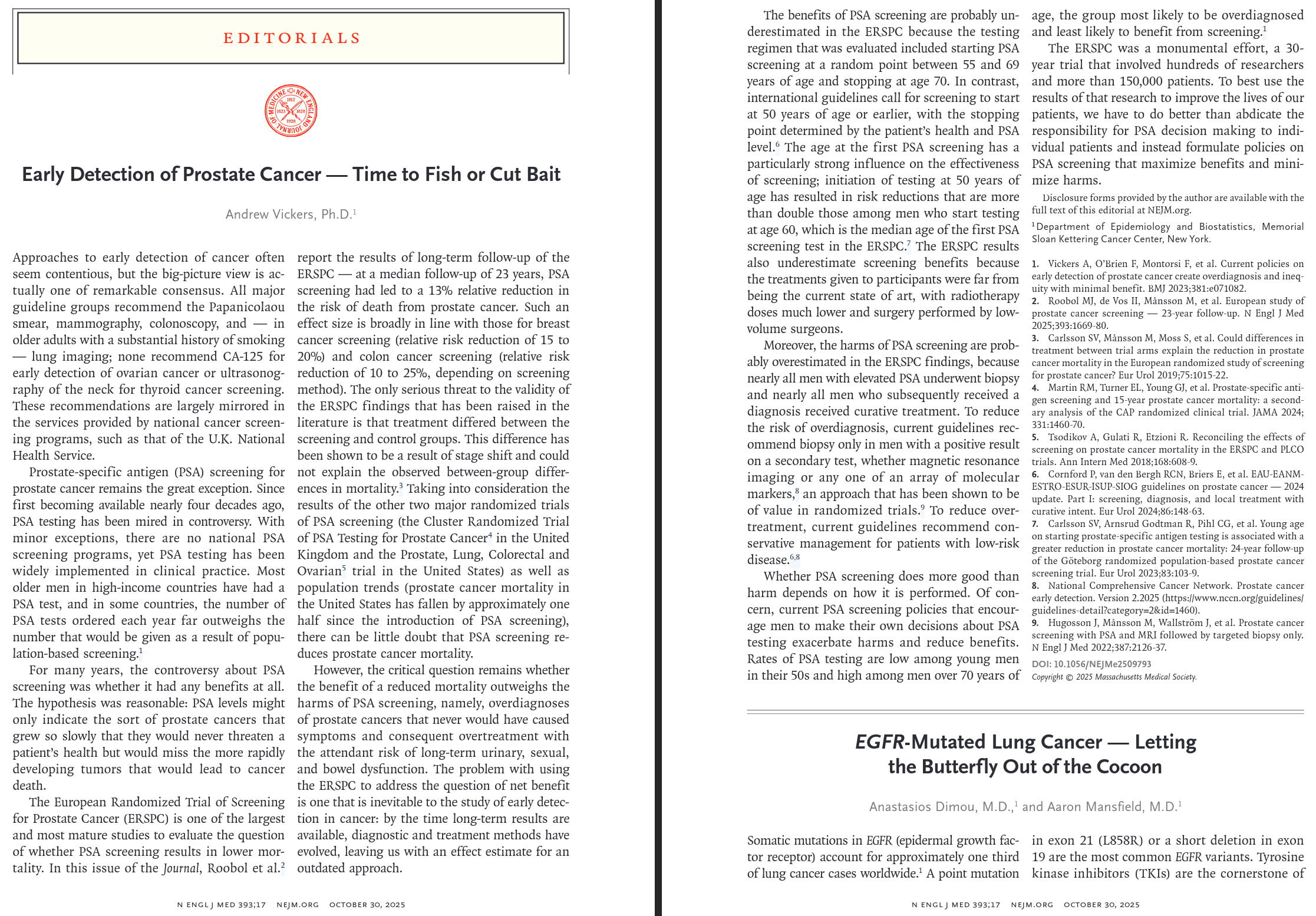
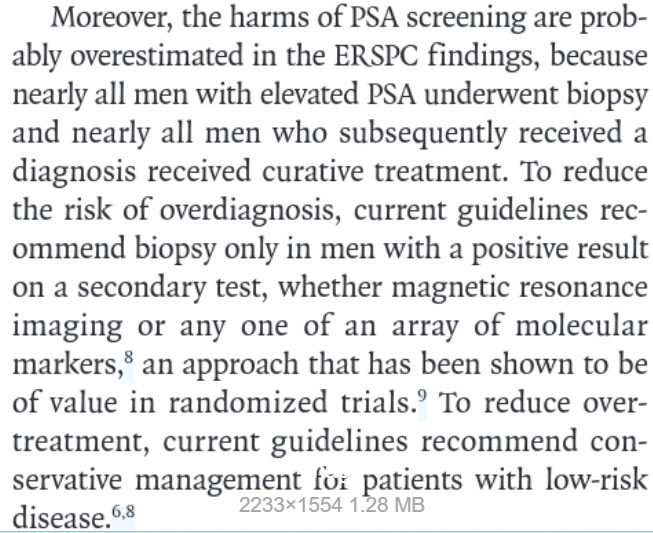
The problem with using the ERSPC to address the question of net benefit is one that is inevitable to the study of early detection in cancer: by the time long-term results are available, diagnostic and treatment methods have evolved, leaving us with an effect estimate for an outdated approach.
The changing landscape of diagnosis and treatment options, specifically for prostate cancer, have evolved notably, even in just the past few years. Those evolving options mean that we are dealing with something of a moving target in trying to establish risk/benefit decision making in this setting, and arguably, here in the US, we are lagging behind other western countries in terms of current and relevant practice guidelines.
Perhaps most prominently, the use of 3T mpMRI as an initial non-invasive pre-biopsy screening option, the use of MRI/US guided fusion biopsies for improved PCa detection, and from a technique perspective, the use of trans-perineal (TP) versus standard trans-rectal (TR) biopsy to reduce procedural bleeding and infection risks, as well as providing better access to the anterior part of the prostate, have all seen increasing utilization and benefit.
I would also envision that, in time, we will likely have better biomarkers for PCa and there are numerous efforts underway in that domain.
From a treatment perspective, for low-risk PCa, the use of active surveillance, has also markedly increased, and provides, at least for a period of time depending upon age and other factors, the opportunity to avoid the side effects of more aggressive interventional treatments.
I can speak with some personal experience, having been on a semi-annual follow up regimen since 2020 due to a spike in my PSA level to 7.6, and with my dad, now 92, as a first degree relative who underwent a robotic RP at age 75 due to a 4+3 Gleason biopsy at the time, along with the attendant side effects.
In mid-2020 I had a 3T mpMRI, which was negative save for an enlarged prostate, and after a second bump in PSA months later with some informed discussion, I had a TP approach biopsy, which was also negative.
Thus, since then and with that information, just dealing with BPH and a fluctuating PSA level between 5.9 and 7.3 for the past three years, albeit the trend is slowly increasing over time. Should there be another marked spike, my urologist and I have agreed to another 3T mpMRI at that time to then facilitate an informed discussion as to next steps.
This approach to my specific care was, at the time back in 2020, less common in the community setting, and after being referred by my primary to a local urologist who turned out to be ambivalent about the use of mpMRI, I ended up self-referring to an academic center some distance away. That initial local urologist now, several years later, openly advertises the use of mpMRI and fusion biopsies on their practice web site. “Crossing the Chasm” anyone?
Given what I do for a living, I would presumably be considered more informed than most prospective patients, not only in having an ability to aggressively review the relevant literature to educate myself along with knowledge of my own risk factors, but also in seeking out physicians who demonstrate a forward thinking perspective. In order to have an informed discussion, both parties need to have a common frame of reference vis-a-vis risks and benefits, with neither one abdicating their role in the discussion. The patient will come to the physician as the presumptive expert in the domain, with some reasonable expectation of being educated as apropos to their choices, so that they can hopefully be an active participant in decision making. While at the end of the day, the ultimate decision maker is the patient, a low-information patient is not helping themselves.
 , but it seems to me that even an NNS would have made a reasonable addition to this piece.