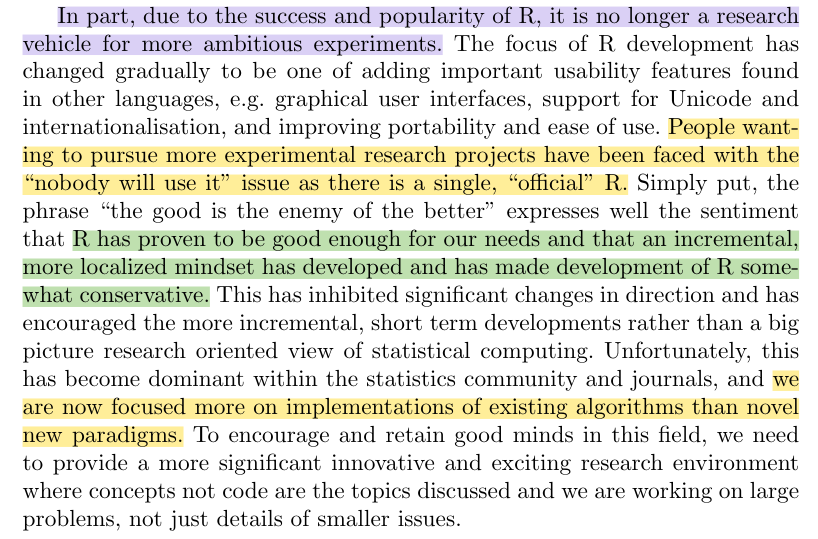
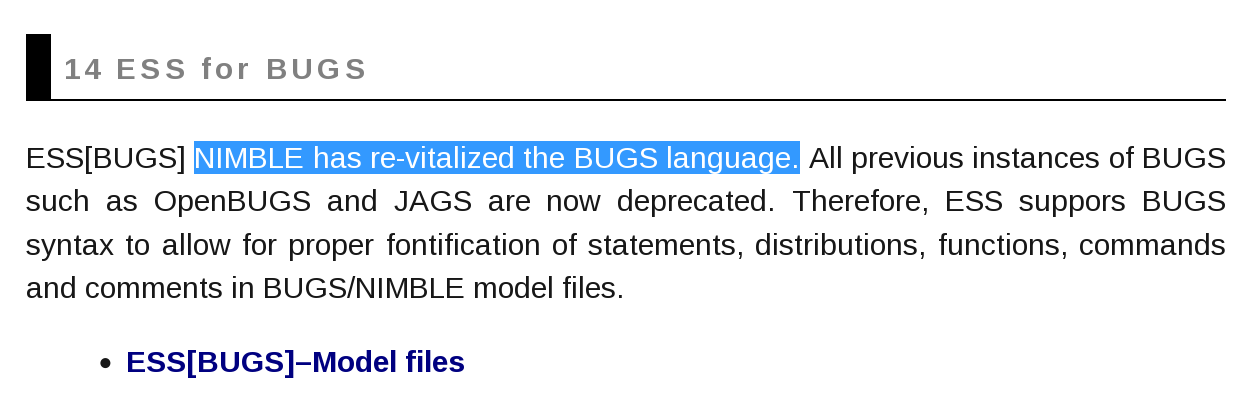
Ross Ihaka and Duncan Temple Lang’s 2008 conference paper [1] (PDF) came to my attention via About Lisp-Stat | Lisp-Stat, and I wonder what happened leading to the (apparent?) abandonment of this idea. Does anybody know?
Ihaka R, Temple Lang D. Back to the Future: Lisp as a Base for a Statistical Computing System. In: Brito P, ed. COMPSTAT 2008. Physica-Verlag HD; 2008:21-33. doi:10.1007/978-3-7908-2084-3_2
I’ve always found it curious that Lisp was considered modern even when it first came out. The amount of work to program in it was off the charts. BTW May 5 is the 50 year anniversary of the first release of S, the precursor to R. It’s fair to say that S/R have had a much longer shelf life than Lisp.
There are recent github commits within the past 2 weeks, but I don’t know of anyone in the computational or mathematical statistics community involved in it.
The stat project that gets any attention outside of R would be Stan, which is implemented in C++. A much less well-known project that takes a unique algebraic approach to modelling (including methods such as agent based models) would be the apophenia library, implemented in C.
A hard copy book on its philosophy was published by Princeton University Press
Finally, a U.S. Census technical paper on an Algebra of Statistical Models
As for Lisp, I’m now feeling burdened by a lot of technical debt from past investments in R (incl. Shiny), and wish I had known enough back then to consider alternatives. The complete path enumeration I implemented (with R6 classes, ugh!) could have been done so much more elegantly (and faster) in Common Lisp. And I bet I could have avoided implementing the CRM in Rust, too.
The only other environment you might have wanted to consider, since you are a fan of Prolog, would be the ECLiPSe environment, which is a Prolog environment dedicated to mathematical constraint programming. Matrices and arrays are part of the language (built-ins as they are known in Prolog). If you were willing to wrap C or C++ code, you could use any stats software written in those languages in ECLiPSe.
Modern Fortran (anything after 1990) is also a worthy mention. There are loads of working Fortran code, but much of it isn’t organized well. There are a number of scientists and engineers working to make development in Fortran much easier, such as a standard library for various programming (including numerical progamming) tasks.