Thank you @AndersHuitfeldt. I have gone through the exercise of using the result of a RCT in a Norwegian cancer centre to estimate what would happen in Wales. Figure 1 shows a ‘P Map’ that sets out simple natural frequencies observed on treatment and control. (I use these ‘P Maps’ for teaching in the 0xford Handbook of Clinical Diagnosis.) There were 100 subjects in the control and treatment limbs and of these, 60/100 were female and 40/100 were male. Of the 60 females in the control limb, a proportion of 8/60 died. Of the 40 males in the control limb, 12 died. In the treatment limb, 6/60 females died giving a RR of 6/60 x 60/8 = 3/4. In the treatment limb, 6/40 males died giving a RR of 4/40 x 40/12 = 1/3.
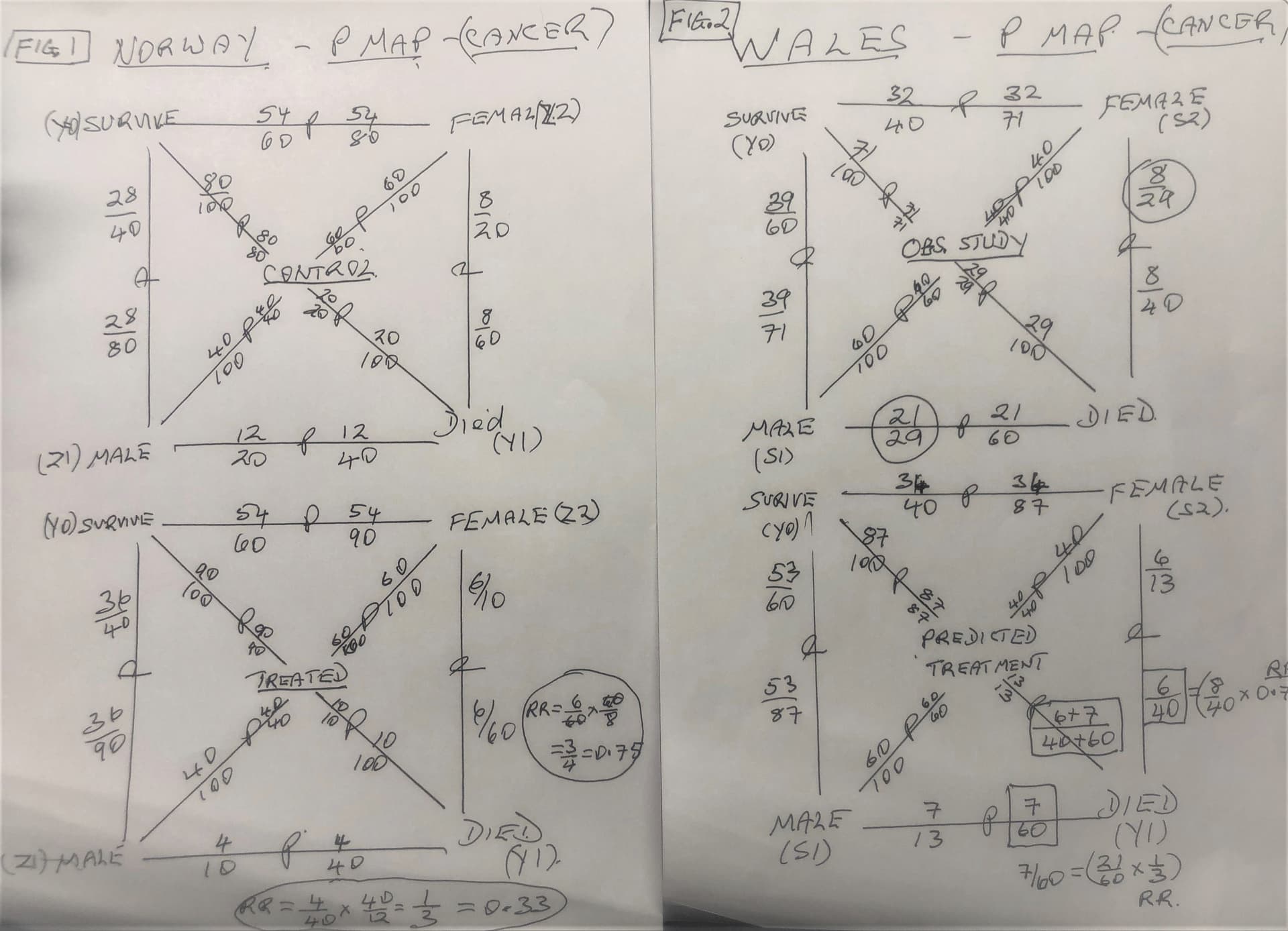
The result of an observation study in a Welsh cancer centre is shown in Figure 2. There were 100 subjects in the study and of these, 40/100 were female and 60/100 male (different to the Norwegian study). Of the 40 females, a proportion of 8/40 died. Of the 60 males, 21 died. Assuming a RR of 3/4 for women, the expected proportion of women who would die with treatment in Wales would be 8/40 x 3/4 = 6/40. Assuming a RR of 1/3 for men, the expected proportion of men who would die with treatment in Wales would be 21/60 x 1/3 = 7/60.
Of the 29 people who died in the observation study, 8 were female and 21 were male. This gave a weight for Welsh men of 21/29 and a weight for Welsh women of 8/29. This gives RRmen x weight for Welsh men = 1/3 x 21/29 = 7/29. For women the RRwomen x weight for Welsh women = 3/4 x 8/29 = 6/29. The resulting estimation of the marginal RR is 7/29 + 6/29 = 13/29 = 0.448.
This result is confirmed by another method, which can be formulated with the insight provided by the ‘P Maps’ that display ‘natural frequencies’. This is done by combining the proportion of Welsh females who would be expected to die on treatment (6/40) with the proportion of Welsh males who would be expected to die on treatment (7/60) to give the proportion of Welsh people who would be expected to die on treatment to give (6+7)/(40+60) = 13/100. The latter represent collapsible natural frequencies. The proportion of Welsh people who died in the observation study was 29/100. From this we can calculate the predicted marginal RR of (13/100)/(29/100) = 0.448, a result that coincides with the approach based on counterfactuals.
‘Natural odds’ are also collapsible and can be combined in the same way. The natural odds for 7/60 are 7/53 and the natural odds for 6/40 are 6/34. These collapse to the natural odds corresponding to the natural frequency for 13/100 thus: (7+6)/(53+34) = 13/87. The marginal odds ratio is therefore (13/87)/(29/71) = 0.366. Note that probabilities, risk differences, risk ratios and odds ratios may not always be collapsible as pointed out by @Sander in his Noncollapsibility, confounding, and sparse-data bias. Part 2: What should researchers make of persistent controversies about the odds ratio? - ScienceDirect but natural frequencies and natural odds are always collapsible in the above way.
Thank you again Anders for your kindness and patience in explaining this approach to me and @f2harrell for helping us all to understand each other better.